
Criminal Court Records in Creek County
A criminal court record is the official file a court opens when the State of Oklahoma charges someone with a crime. In Creek County the file lives with the Court Clerk, the elected officer who files and keeps every District Court record. The clerk runs two divisions, one in Sapulpa and one in Bristow, and a case sits in the division where it was filed. The record holds the charging document, the docket, every motion and order, the plea, and the final judgment. It is built one case at a time, so a single person can have more than one file.
Most adult crimes in Creek County are heard in the District Court, the trial court of general jurisdiction. Felony cases carry the heaviest penalties and usually open with a case number that starts with CF. Misdemeanor cases are lower-level offenses and often start with CM. City offenses work differently. A Sapulpa or Bristow city ticket or ordinance violation begins in municipal court and does not appear in the District Court file unless it is later tied to a district case. The court that handles the case decides where the criminal record is kept.
How to Search Creek County Criminal Court Records
Criminal cases are searched online through two official systems. The Oklahoma State Courts Network, known as OSCN, hosts a free docket search that lists Creek County District Court and the Creek (Bristow) District Court. The Court Clerk also points the public to On Demand Court Records at odcr.com, a participating-court portal that both the clerk and the Sheriff link. Either tool can pull a case by name or by case number.
- Open the OSCN docket search and choose Creek County District Court or the Bristow division from the court dropdown.
- Search by the defendant's name, or enter the case number directly when you have it, such as a CF or CM number.
- Narrow the results by case type and filing date so the right case rises to the top.
- Open the case to read the docket, the charges, and the disposition entered by the judge.
- Ask the Court Clerk for a certified copy when an online printout will not satisfy a legal need.
Statewide tools add depth. The Oklahoma Department of Corrections offender lookup shows people sentenced to state custody, which helps when a Creek County felony ended in a prison term. For records the portals do not show, such as older files or sealed matters, call the Sapulpa or Bristow Court Clerk division that holds the case. A closer look at the charges themselves sits on the Creek County arrest records and court charges page.
Note: OSCN and ODCR are public conveniences, and under Court of Criminal Appeals Rule 2.6 the court's own case-management record controls if the two ever disagree.
Stages of a Creek County Criminal Case
A criminal case moves through fixed stages, and each one leaves a mark in the file. The case opens when the District Attorney files the charges. The defendant is arraigned, enters a plea, and bond is addressed. Pretrial work follows, where lawyers file motions and exchange evidence. The case then ends in a plea or a trial, the judge enters a disposition, and a sentence is imposed when there is a conviction. The docket lists each of these events with a date, so the record reads like a timeline of the case.
Case flow: Charges Filed › Arraignment › Pretrial / Motions › Plea or Trial › Disposition › Sentencing
| Stage | What Happens |
|---|---|
| Arraignment | The defendant first appears, hears the charges read, enters an initial plea, and the judge sets bond and addresses counsel. |
| Pretrial / Motions | Lawyers exchange evidence and file motions to limit, add to, or dismiss parts of the case before trial. |
| Plea or Trial | The case resolves by a guilty or no contest plea, or it goes to trial before a judge or a jury. |
| Sentencing | After a conviction or plea, the judge imposes punishment such as fines, probation, jail, or a prison term. |
What a Creek County Criminal Court Record Shows
The criminal file is built around a set of standard fields. Read together, they tell who was charged, with what, and how the case ended. The same fields appear whether the case is a low-level misdemeanor or a serious felony, though the detail grows with the weight of the charge. Financial entries also show up, including fines, court costs, restitution, and any bond posted for release.
| Field | What It Shows |
|---|---|
| Case Number | The unique identifier for the case, such as a CF number for a felony or a CM number for a misdemeanor. |
| Defendant | The person charged. In a criminal case the opposing party is the State of Oklahoma. |
| Charges | Each offense filed, listed by statute, count, and severity level. |
| Plea | The defendant's answer to each charge, usually guilty, not guilty, or no contest. |
| Disposition | The outcome of each charge, such as convicted, dismissed, acquitted, or deferred. |
| Sentence | The punishment after a conviction, from fines and probation to jail or prison time. |
Who Files Charges in Creek County
Criminal charges in Creek County are filed by the District Attorney, not by the police or the jail. District 24 covers both Creek and Okfuskee Counties, and District Attorney Max Cook runs the Creek County office from the courthouse in Sapulpa. The prosecutor reviews the arrest, decides which charges the evidence supports, and files them with the Court Clerk as the State's case. That filing, not the arrest itself, is what opens the court record.
The Oklahoma District Attorneys Council publishes the District 24 office page with the Creek County contact and payment details.
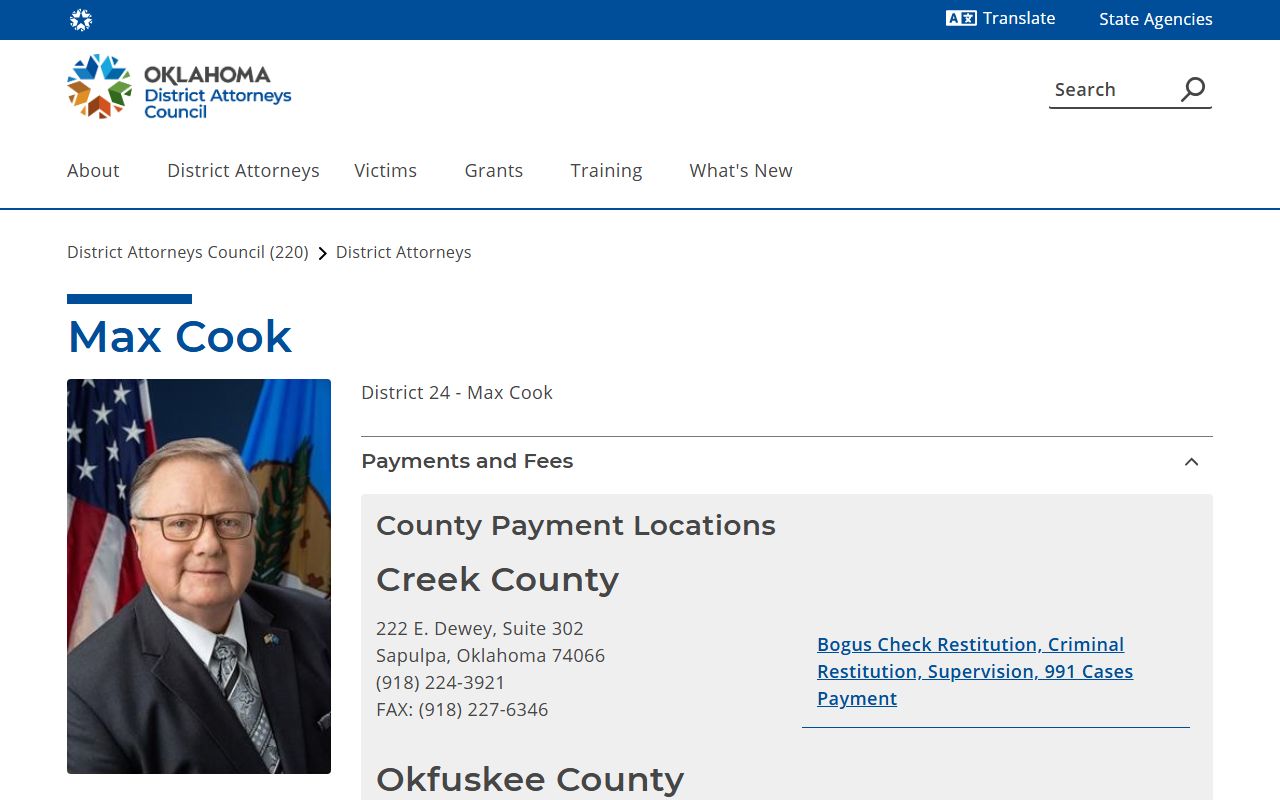
The same Sapulpa office also accepts restitution and supervision payments tied to criminal cases, which is why the District Attorney appears at several points in a Creek County criminal file.
District Attorney, District 24
222 East Dewey, Suite 302
Sapulpa, OK 74066
918-224-3921
Serves Creek and Okfuskee Counties
Charges vs. Convictions
Being charged is not the same as being convicted. A criminal court record can show charges that were later dropped, dismissed, or ended in acquittal, and those charges still sit in the file even though no guilt was ever found. A charge is only an accusation by the State. A conviction is a finding of guilt entered by the court after a plea or a verdict. Reading the disposition for each count is the only way to tell the two apart.
| Charge | Conviction | |
|---|---|---|
| Stage | Accusation | Verdict or plea |
| Burden of Proof | Probable cause | Beyond reasonable doubt |
| Public Record | Yes | Yes |
Reading Creek County Criminal Dispositions
The disposition is the part of the record that tells how a charge ended. A guilty plea or a guilty verdict produces a conviction. A not guilty verdict is an acquittal. A dismissed charge is dropped by the court, often on the prosecutor's motion. A no contest plea, sometimes written as nolo contendere, accepts the punishment without admitting guilt. A deferred sentence holds judgment open while the defendant meets conditions, and the case may later be dismissed if those conditions are met.
The sentence follows the disposition. It may list jail or prison time, a fine, court costs, restitution to a victim, probation, or a mix of these. A suspended sentence means part of the term is held back as long as the defendant stays out of trouble. Because Oklahoma criminal files use short docket codes for these outcomes, the safest read is to open the full case and follow each count rather than rely on a single summary line.
Public Defenders in Creek County Cases
A defendant who cannot afford a lawyer in a Creek County felony or misdemeanor case is entitled to appointed counsel. That representation runs through the Oklahoma Indigent Defense System, known as OIDS, which staffs a Non-Capital Trial office that covers Creek County from a Sapulpa satellite. Appointment is decided by the court based on financial need, and the appointed lawyer then appears in the same case file as any private attorney.
The state describes the program and its county coverage on the OIDS Creek County page.
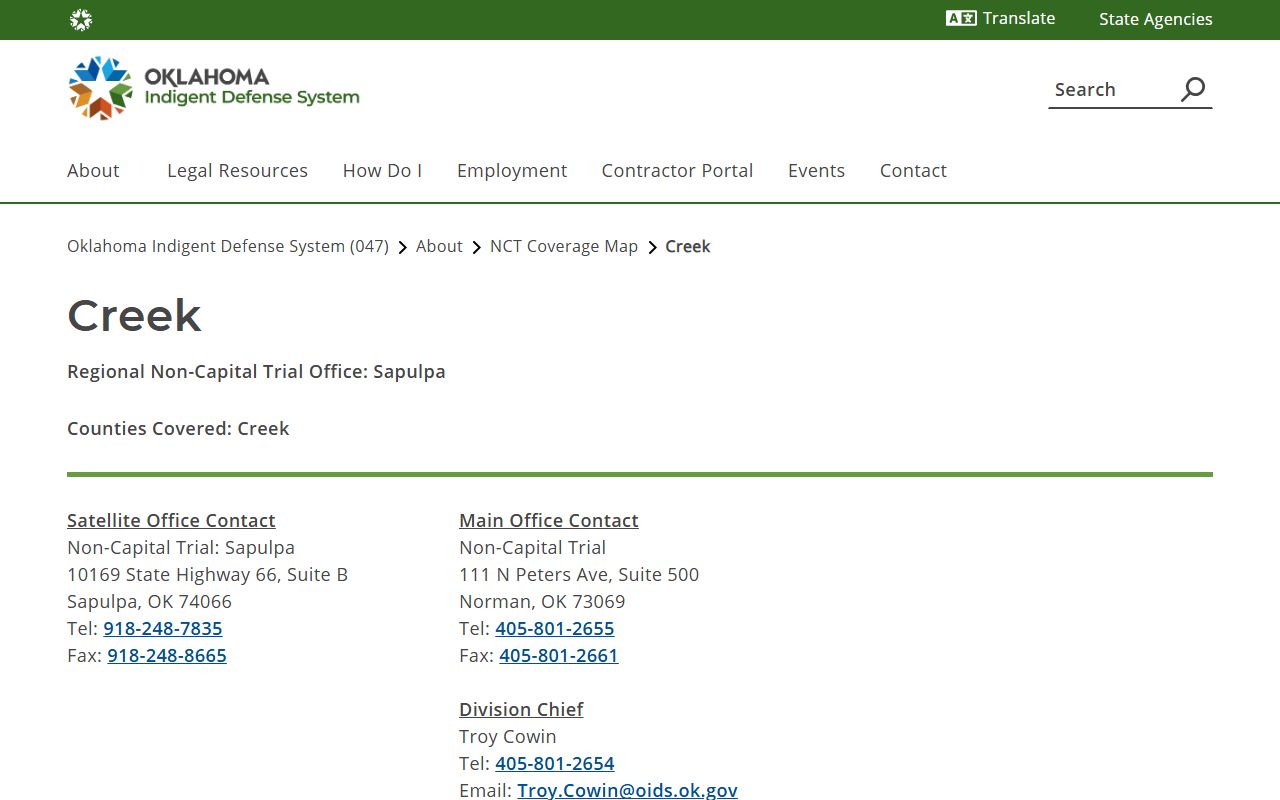
Because the defense lawyer files motions and appearances in the docket, the record shows whether a defendant was represented by appointed or retained counsel as the case moved forward.
Warrants and Booking in Creek County Criminal Cases
Two records often get confused with the court file. The first is the warrant. A judge may issue an arrest warrant to start a case or a bench warrant when a defendant misses a hearing, and those warrants appear in the District Court docket when they are public. The second is the jail booking record, created by the Sheriff at the moment of arrest. The booking record is a custody record, not a court charge, and the two do not always match because the prosecutor can file different charges than the ones listed at booking.
For who is currently in custody, the jail roster is a Sheriff record rather than part of the court file. The court record picks up once the District Attorney files the formal charges, after which the warrant, the bond, and every hearing flow into one docket. Keeping the booking record and the court record separate is the key to reading a Creek County criminal case correctly.
Sealed vs. Expunged Records
Some criminal records can be removed from public view, but the process is not automatic and it is not an online edit. In Oklahoma, sealing and expungement run under Title 22, Sections 18 and 19. A person identifies the record, confirms which eligibility category fits, files a petition in the proper District Court case, and serves the agencies the statute names, such as the prosecuting authority, the arresting agency, and the Oklahoma State Bureau of Investigation. The court may set a hearing, and if the judge grants the request a signed order directs the custodians to seal or update public access.
The Oklahoma statutes that govern this are posted through the state expungement and sealing law.
After an order is entered, OSCN, ODCR, the Court Clerk, and state repositories may stop showing the record to the general public, while authorized criminal justice access can remain.
| Sealed | Expunged | |
|---|---|---|
| Visibility | Hidden from public | Destroyed / treated as never existed |
| Law Enforcement | Limited access | Very limited |
| Eligibility | By category under 22 O.S. 18/19 and court order | By category under 22 O.S. 18/19 and court order |
Public Access to Creek County Criminal Records
Criminal case files in Creek County are public in most situations. The Oklahoma Open Records Act treats the records of public bodies and officials as open for inspection and copying unless an exemption applies, and District Court case files fall under that rule. Online portals carry this access to anyone with a browser, while the Court Clerk holds the certified version. The main limits come from sealing orders, juvenile confidentiality, and the redaction rules that strip out sensitive personal data.
Key Statutes:
Oklahoma Open Records Act, 51 O.S. 24A.5 - records of public bodies and officials are open for inspection, copying, or mechanical reproduction.
Court of Criminal Appeals Rule 2.6 - the OSCN online search is a public convenience, but the court's case-management record controls if there is a discrepancy.
Expungement and sealing, 22 O.S. 18/19 - governs when a qualifying criminal record can be sealed from public access.
Background Check Considerations
A casual case lookup and a formal background check are not the same thing. Searching OSCN or ODCR for a name tells you what is publicly filed, but it is not a regulated report. A background check used for hiring, housing, credit, or a license must follow the federal Fair Credit Reporting Act, which sets accuracy and notice rules that a free court search does not provide. Anyone making a decision that the law covers should use a qualified screening provider rather than a casual public search.
Important: This website is not a consumer reporting agency under the Fair Credit Reporting Act, and its information may not be used for credit, employment, tenant, or insurance decisions.
Restricted Criminal Court Records in Creek County
Not every criminal matter is open to the public. Juvenile cases are handled under confidentiality statutes and are not posted like adult dockets. Sealed and expunged cases drop out of normal search results once a judge signs the order. Adoption, mental health, and civil commitment files are tightly limited and usually require party status, counsel, or a court order. Public versions of any file also strip out Social Security numbers, financial account numbers, and protected victim or minor details.
When a case does not appear online, that absence is not proof it does not exist. Older files may not be digitized, and restricted matters are simply withheld from public view. For the broader set of Creek County court records across civil, family, and probate matters, the same Court Clerk divisions in Sapulpa and Bristow hold the official files and can confirm what is releasable.