
Creek County Arrest Records and Court Charges
A Creek County arrest record is the record of an arrest itself. It captures who was taken into custody, which agency made the arrest, and the booking that follows at the county jail. An arrest record is not a finding of guilt. It only shows that an officer had grounds to take the person in. Once that arrest happens, a prosecutor reviews the facts and decides what, if anything, to file. Those filed charges become the court charge record, kept by the Court Clerk as part of a District Court case.
The two records sit on different sides of the system. The arrest and booking side is a Sheriff record, and the live custody list is the Creek County jail roster on the inmate records page. The court charges after arrest are a court record, opened when the District Attorney files a charging document and tracked through the case from there. The full case file, with the plea, the disposition, and the sentence, sits on the Creek County criminal court records page. Booking shows custody; the charge record shows the accusation.
The Sheriff's Office explains how to obtain arrest and incident reports on its records request page.
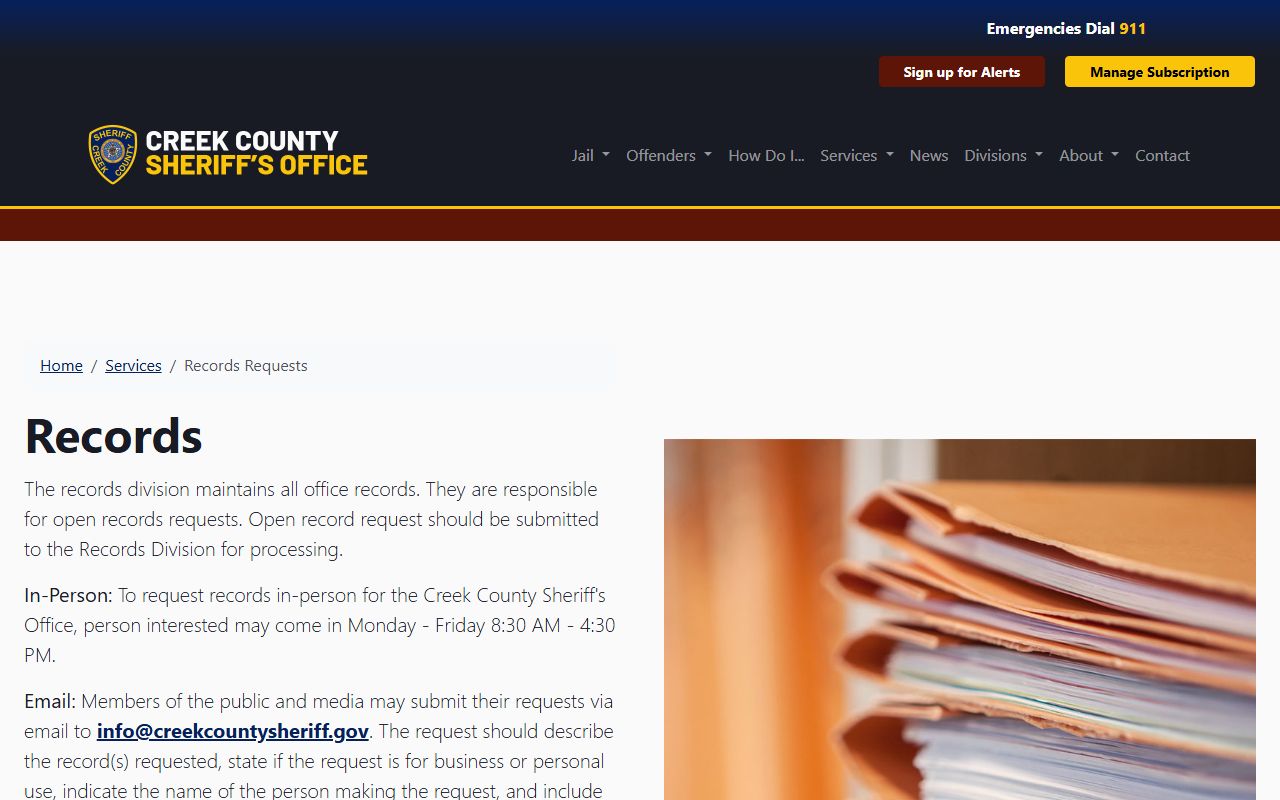
That request channel covers the law-enforcement side of an arrest record, while the charges filed afterward are searched through the court portals.
How to Find Creek County Arrest Records
Charges are found through the same court portals that hold the rest of a case. The Oklahoma State Courts Network and On Demand Court Records both list Creek County District Court, and a search by name or case number returns the charges filed against a defendant. Arrest and booking detail is a separate Sheriff record, so the jail roster and the court charge index are checked in different places.
- Open the OSCN docket search or ODCR and select Creek County District Court.
- Search by the defendant's name, or by case number when you have it.
- Open the case and read the charge list filed by the State.
- Check each charge for its statute code, severity level, and current status.
Charges that lead to a state prison sentence also appear in the Oklahoma Department of Corrections offender lookup, a statewide tool. For an arrest report itself, the Sheriff's records process is the law-enforcement channel rather than the court portal.
Arrest Charge vs. Filed Charge in Creek County
The charge listed at booking is not always the charge the State pursues. When the Sheriff books a person, the jail records the offense the arresting officer cited. That booking charge starts the custody record, but it is only a starting point. The District Attorney then reviews the arrest and decides the formal counts. The prosecutor can file the same charge, a different one, more counts, fewer counts, or decline to file at all. This is why a jail booking charge and the court charge in a Creek County case often read differently.
The gap matters when reading records. A booking charge shows what an officer alleged at the scene. A filed charge shows what the State is actually prosecuting. The filed charge is the one that drives the case, sets the severity level, and appears in the District Court docket. For the booking side, the jail roster is the source. For the filed charge and everything that follows it, the court file is the source.
How Creek County Charges Get Filed
The charge record begins when the prosecutor files a charging document. The arrest may put a person in jail, but it is this filing that formally starts the criminal case and lists the counts. Oklahoma uses three main charging documents, and the type depends on the seriousness of the offense and whether a grand jury is involved. In District 24, which covers Creek and Okfuskee Counties, the District Attorney is the office that files these charges for the State.
| Complaint | Information | Indictment | |
|---|---|---|---|
| Filed By | Officer / Prosecutor | Prosecutor | Grand Jury |
| Common For | Misdemeanors | Many felonies | Serious felonies |
| Starts | The case | The case | The case |
The right document depends on the level of the offense. A complaint or an information is the usual route for misdemeanors and many felonies in Oklahoma, and the prosecutor signs and files it with the Court Clerk. An indictment is different because it comes from a grand jury rather than the prosecutor alone, and it is reserved for the most serious matters. Whichever document opens the case, the counts it lists become the charge record the public can search through the court portals.
How Charge Status Changes in Creek County
Charges are not fixed once filed. As a case moves, the prosecutor and the court can change them. A charge can be amended to a different offense, reduced to a lesser one, added, dropped, or dismissed. Reading the status next to each count shows where that charge stands, which matters because an arrest charge and the final filed charge are often not the same.
| Status | What It Means |
|---|---|
| Pending | The charge has been filed and the case is still open, with no final outcome yet. |
| Amended / Reduced | The charge has been changed to a different or lesser offense as the case developed. |
| Dismissed | The charge has been dropped by the court and will not proceed to judgment. |
| Nolle Prosequi | The prosecutor has formally chosen not to pursue the charge, ending it without a conviction. |
Charges vs. Convictions
Being charged is not the same as being convicted. A filed charge is the State's accusation, supported only by probable cause. A conviction is a finding of guilt entered after a plea or a trial, under the much higher standard of beyond a reasonable doubt. A Creek County charge record can show counts that were later dismissed or that ended in acquittal, so the conviction status of each charge is what tells the real outcome.
This distinction protects people whose charges never led to a conviction. An arrest and a filed charge can sit in the public record even when the case ended without guilt. Anyone reading a charge record should check the disposition of each count before treating it as proof of wrongdoing, because the accusation and the outcome are two separate facts.
| Charge | Conviction | |
|---|---|---|
| Stage | Accusation | Verdict or plea |
| Burden of Proof | Probable cause | Beyond reasonable doubt |
| Public Record | Yes | Yes |
Sealed vs. Expunged Records
Some arrest and charge records can be sealed or expunged, but only by court order under Oklahoma law. Title 22, Sections 18 and 19 set the eligibility categories. A person files a petition in the District Court case, serves the prosecuting authority and the arresting agency, and the court decides whether to grant it. A sealed record is hidden from public search. An expunged record is treated as though it never existed for most purposes, though limited criminal justice access can remain.
| Sealed | Expunged | |
|---|---|---|
| Visibility | Hidden from public | Destroyed / treated as never existed |
| Law Enforcement | Limited access | Very limited |
| Eligibility | By category under 22 O.S. 18/19 and court order | By category under 22 O.S. 18/19 and court order |
Creek County Charge Codes and Levels
Each charge ties to a statute, and that statute fixes the severity level. Oklahoma sorts offenses mainly into felonies and misdemeanors. Felonies are the most serious and often carry case numbers that begin with CF. Misdemeanors are lower-level offenses and often carry CM numbers. Lesser violations, such as some traffic or municipal matters, are handled as infractions or city ordinance counts. One arrest can produce several separate charges at once, each with its own code, level, and status, which is why a single case may list more than one count.
The level matters because it shapes the rest of the case. A felony count carries the heaviest penalties and the most procedure. A misdemeanor count is lighter but still part of the public charge record. City ordinance counts from Sapulpa or Bristow are handled in municipal court and are tracked separately from a Creek County District Court case. Reading the code beside each charge is the fastest way to tell which level, and which court, a count belongs to.
Statewide Lookups for Creek County Charges
Charges that end in a state sentence move beyond the county file. The Oklahoma Department of Corrections runs a statewide offender lookup for people sentenced to its custody, which helps when a Creek County felony charge resulted in a prison term. It is the closest thing the state offers to a single public search across criminal history.
The state hosts the Oklahoma DOC offender lookup for sentenced offenders.
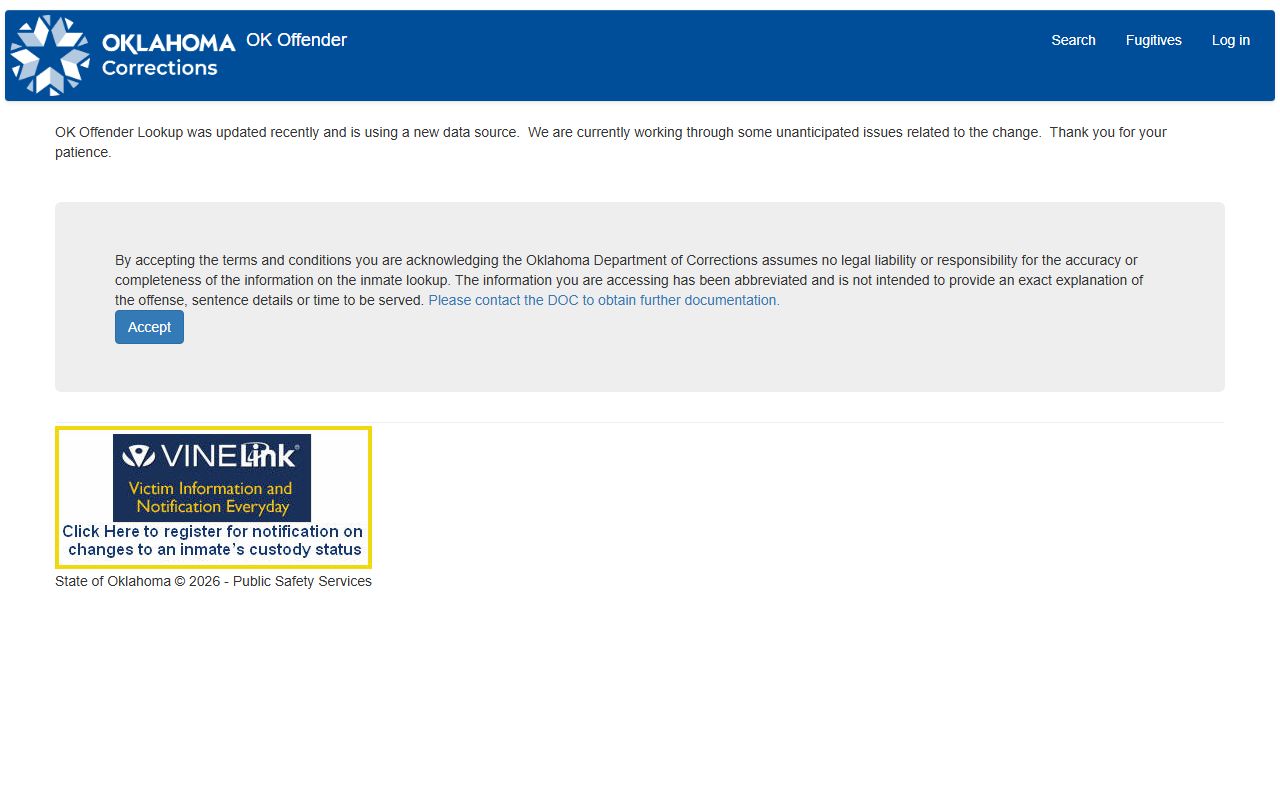
The department warns that its data is abbreviated and is not an exact statement of the offense, the sentence, or time to be served, so the underlying court file remains the better source for charge detail. Documentation should be confirmed with the department directly.
More on those services appears on the ODOC offender information page.
Together these statewide tools fill the gap after a person leaves county custody, but they do not replace the Creek County charge record held by the Court Clerk.
Background Check Considerations
A quick charge lookup and a formal background check are different things. Searching the court portals shows what charges are publicly filed, but it is not a regulated report. Any check used for employment, housing, credit, or licensing must follow the federal Fair Credit Reporting Act, which adds accuracy and notice duties that a casual public search does not carry. Decisions the law covers should rely on a qualified screening provider.
Important: This website is not a consumer reporting agency under the Fair Credit Reporting Act, and its information may not be used for credit, employment, tenant, or insurance decisions.
Restricted Charge Records in Creek County
Not every charge record is open. Juvenile charges are confidential and are not posted like adult cases. Charges that have been sealed or expunged drop out of public search once a judge signs the order. Some dismissed counts and records tied to active investigations may also be withheld. Public versions of any file leave out Social Security numbers, financial account numbers, and protected victim or minor details. When a charge does not show online, that gap reflects access rules, not proof the record never existed.